Two critical PHP flaws: AI helped uncover them; operators still need to patch
Two critical vulnerabilities in PHP allow remote code execution without authentication. AI tools contributed to their discovery, according to the programme partners. Fixes are available; the risk now also depends on how quickly operators update.
Translated from the French original. In case of discrepancy, the French version prevails.
On 20 October, PHP’s security team announced an urgent release for two critical vulnerabilities. The following day, fixed versions became available. CERT-EU urged organisations to apply the updates immediately or temporarily isolate exposed services that cannot yet be patched. [1][2][1][2]
Two flaws with reach across the web stack
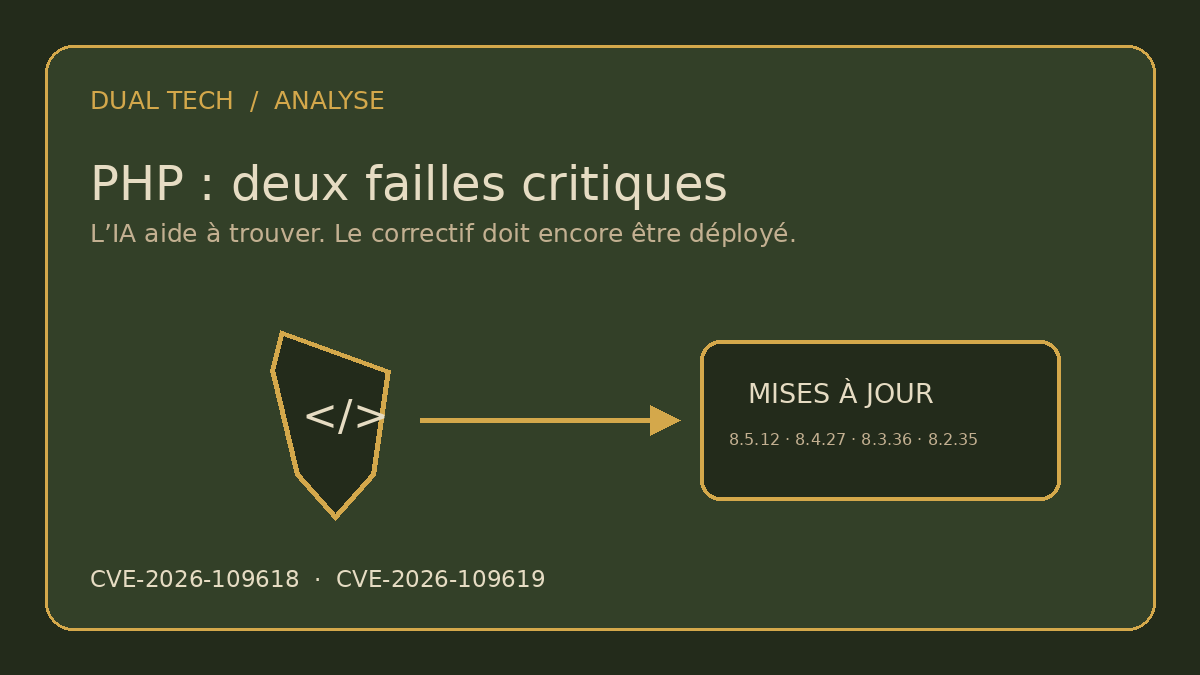
PHP released versions 8.5.12, 8.4.27, 8.3.36 and 8.2.35. The flaws, CVE-2026-109618 and CVE-2026-109619, each received a CVSS v4 score of 9.2 out of 10. CERT-EU says they can allow an unauthenticated attacker to execute code remotely on installations serving web requests. [1][2][1][2]
The European advisory distinguishes supported branches from older releases. PHP 8.1 and earlier no longer receive updates from the PHP project, although some vendors provide backported fixes. Operators need to check the version actually running and follow their supplier’s guidance, including when PHP is embedded in a third-party product. [2][2]
What role did AI play?
In its 21 October account, OpenAI says Calif identified one flaw using GPT‑5.6 Sol through Patch the Planet. The company says Wiz independently discovered and reported both vulnerabilities. PHP maintainers led the fixes and release; partners contributed testing, protections and coordination before disclosure. [3][3]
This attribution comes from a participant in the response. It records the role claimed by its partners, but is not by itself an independent assessment of the model’s exact contribution. OpenAI describes a response involving researchers, maintainers, infrastructure providers and public agencies. For a vulnerability affecting a widely reused component, this coordination can give operators time to prepare updates before technical details circulate. [3][3]
Discovery is not protection
The immediate task is deploying the fix. An organisation needs to know where PHP runs, including in legacy applications and hosted services; identify the affected branch; test the update; and verify that every instance has been patched. CERT-EU says no temporary measure fully fixes the flaws: installing a corrected version remains necessary. [2][2]
The disclosure window also mattered. PHP’s initial notice on 20 October announced a release for the next day without revealing details. CERT-EU says the fixes were released at 13:30 UTC; PHP announced PHP 8.5.12 at 14:10 UTC. The short window illustrates the trade-off: prepare the ecosystem in advance, then publish information quickly enough for users to protect themselves. [1][2][4][1][2][4]
69.3% of known sites use PHP — not 69.3% vulnerable sites
As of 21 October 2026, W3Techs estimates that PHP is used by 69.3% of websites whose server-side programming language is known. This measure of language use does not indicate how many sites are vulnerable or compromised. Actual exposure depends on the installed version, configuration, network access and patch deployment. [5][5]
The dual-use link is concrete: the same code-analysis capability can help secure civilian software, public services or defence infrastructure. But wider access to automated research may also shorten the time defenders have to respond. The PHP episode does not show that AI attacked websites; it shows that advantage depends on coordination between discovery, validation, disclosure and remediation. This is our analysis, separate from the facts reported by the sources.
As research accelerates, security also depends on whether organisations can inventory and patch their systems in time.
What the documents do not establish
What the official narrative doesn't tell you
- That 70% of websites were vulnerable or compromised.
- That AI alone found both flaws: the sources describe several teams and an independent discovery by Wiz.
- That temporary protections can permanently replace official updates.
Fact-check
The fact-check, point by point
PHP updates are available and applying them is the priority. AI contributed to the research according to programme participants; security now depends on each operator’s ability to identify and patch affected systems.
Claims checked
Verified On 21 October, PHP released fixes for two vulnerabilities rated CVSS 9.2 that can lead to remote code execution.
Sourced counter-arguments
OpenAI says Calif identified one flaw with GPT‑5.6 Sol; Wiz says it independently discovered and reported both.[3]
Questions that remain open
- What public measure will show how widely the fixes have been deployed?
- How much of discovery and validation came from models, researchers and maintainers respectively?
- Which older releases have backported fixes, and on what timeline?
In short
PHP updates are available and applying them is the priority. AI contributed to the research according to programme participants; security now depends on each operator’s ability to identify and patch affected systems.
Sources
- PHP 8.5.12 Released — annonce officielle — PHP · accessed 21 October 2026
- Security Advisory 2026-018 — Critical Vulnerabilities in PHP — CERT-EU · accessed 21 October 2026
- Patch the Planet: global response coordination as agents uncover critical vulnerabilities — OpenAI · accessed 21 October 2026
- PHP security release announcement, 20 October 2026 — PHP · accessed 21 October 2026
- W3Techs — PHP usage statistics, October 2026 — W3Techs · accessed 21 October 2026
AI-assisted content: this article was written with the help of artificial intelligence from public sources, then reviewed and approved by a human editor before publication. Spotted an error, want to respond? Exercise your right of reply · our method.