Space AI: the hardest test comes after launch
Processing imagery in orbit can speed up its use. European work on Φsat-2 also reveals the central challenge: making models work on real spacecraft data.
Translated from the French original. In case of discrepancy, the French version prevails.
Computing is moving from ground processing centres onto satellites. As SPAICE is scheduled for 21–23 October at ESTEC in the Netherlands, one question deserves attention beyond model size: how well do these systems perform when faced with real flight data?[1]
Select before transmitting
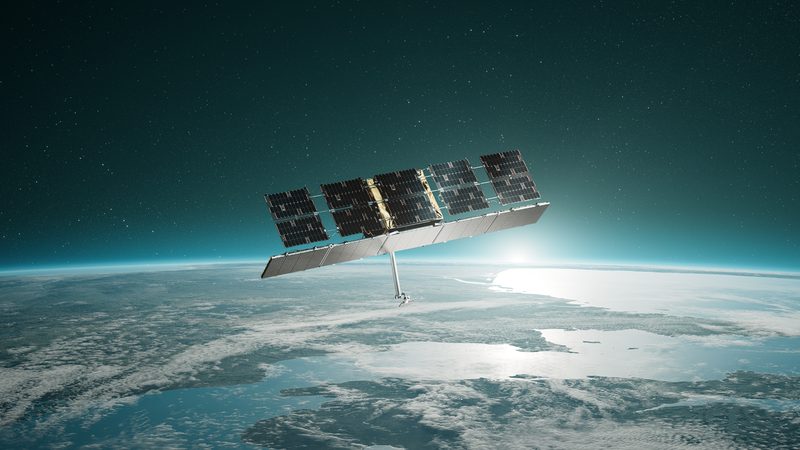
Launched in August 2024, Φsat-2 is a European onboard-processing demonstrator. ESA associates it with cloud filtering, vessel detection, image compression and wildfire monitoring, among other applications. That list describes programme applications, rather than a catalogue of fully qualified commercial services.[2]
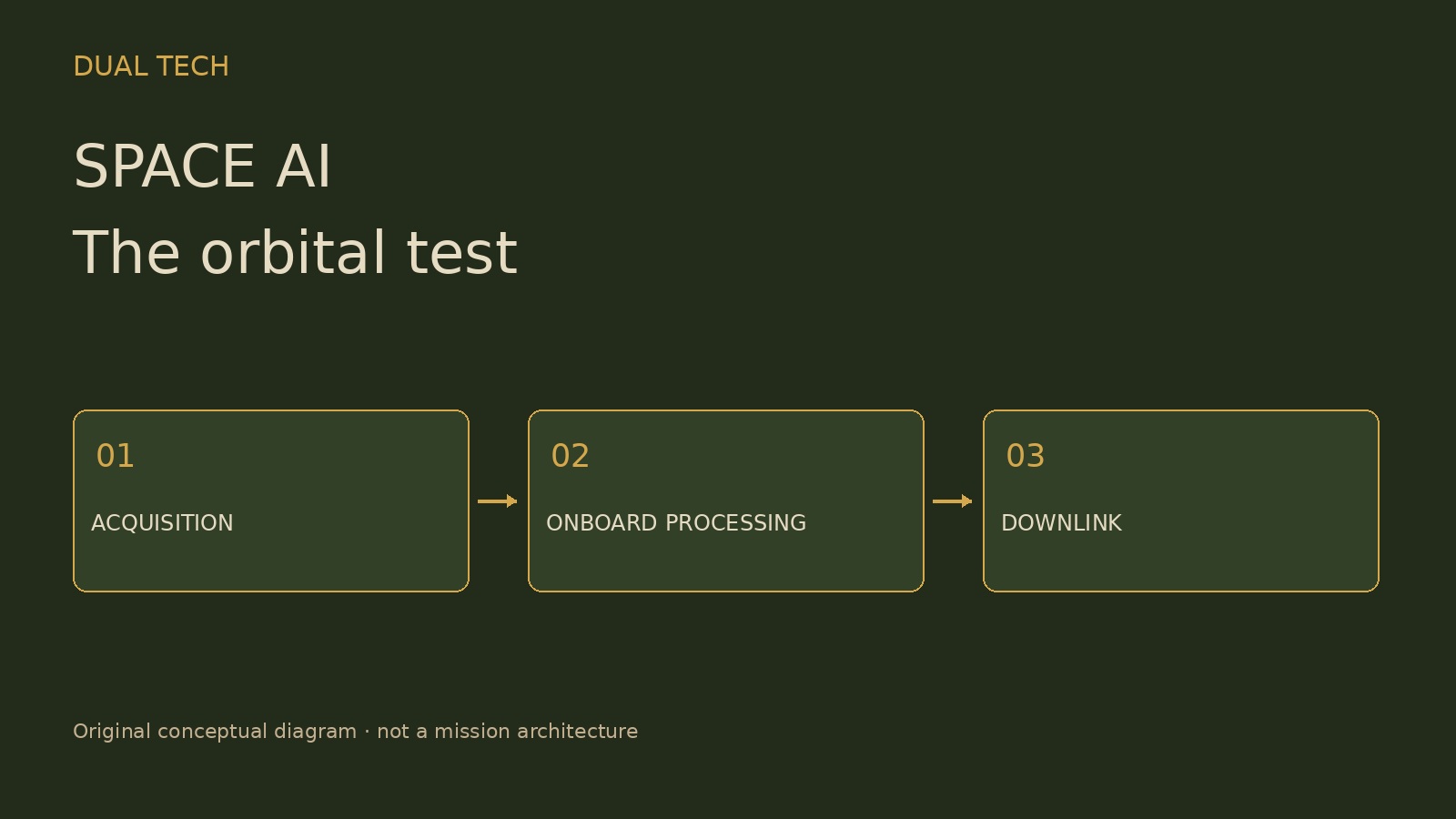
The principle is straightforward: software can select or transform information before transmission instead of always downlinking the entire image. ESA already presents onboard filtering as a way to use the downlink more efficiently. Processing locally must be distinguished from analysing satellite imagery in a ground centre.[6]
Orbit does not always match the training set
A manuscript submitted to arXiv on 8 October describes marine anomaly detection on Φsat-2. Its authors report a mismatch between simulated and real imagery, followed by retraining on flight data. They distinguish functional operation from scientific validation. The submission is not independent certification.[3]
Preprocessing matters too. A Φ-lab research project studies faster reconstruction of raw images. Its account underlines an easily overlooked point: an AI accelerator cannot guarantee a fast processing chain when data preparation remains the bottleneck.[4]
Another project investigates resistance to noise, blur, haze and spectral misalignment. Its page states that the collaboration has not yet produced a peer-reviewed publication. Such research illuminates the challenges; it does not establish universal robustness in service.[5]
Dual-use potential depends on the service delivered
Our analysis: detecting a marine anomaly may support environmental protection, rescue or area monitoring. Defence organisations could use related functions. This is an assessment of potential applications; the sources reviewed establish neither military deployment of Φsat-2 nor autonomous targeting capability.
A useful measure would be the time from acquisition to information the recipient can use, compared with ground processing under equivalent conditions. Evaluation should include false alerts, missed events, communication interruptions and the ability to examine the original image.
Demonstrations need evidence across the entire chain
For procurement, we propose four requirements: representative tests, a documented computing budget, measured errors and a recovery mode. Improvements to one stage must not automatically be treated as mission-wide gains. Even a rapidly generated alert may still wait for transmission or interpretation.
Processing autonomy alone does not establish service sovereignty. Our assessment would also examine hardware, updates, the ground segment and operational control. These questions require programme-specific evidence; describing a system as European does not resolve them.
Progress depends on the whole chain: turning an acquisition into verifiable information while it can still be useful.
What the reviewed documents do not establish
What the official narrative doesn't tell you
- A universal latency or bandwidth improvement across all missions.
- Operational availability of every application announced for Φsat-2.
- Military qualification or autonomous targeting capability.
Fact-check
The fact-check, point by point
The sources distinguish institutional presentations, scientific experience and exploratory research. Procurement criteria and dual-use potential are our analysis. No SPAICE 2026 results are inferred from its announcement.
Claims checked
Sourced counter-arguments
Flight experiments are a useful step; their limitations do not invalidate experimental work.[3]
Questions that remain open
- What end-to-end delays and false-alert rates have been measured under representative conditions?
- Which applications have been validated in orbit, and within what scope?
- How are updates, original data and a return to ground processing managed?
In short
Onboard AI offers concrete functions. Operational value needs application-specific assessment across the full chain.
Sources
- SPAICE 2026 — ESA · accessed 21 October 2026
- Two Φ-lab supported satellites, ESA Φsat-2 and SmartSat CRC Kanyini, take AI to new heights — ESA Φ-lab · accessed 21 October 2026
- Onboard Marine Anomaly Detection on Φsat-2: From Simulation-Based Development to In-Orbit Demonstration — Szywala et al. / arXiv, 8 October 2026 · accessed 21 October 2026
- Raw-to-Processed in Orbit: Fast Onboard Image Reconstruction for EO — ESA Φ-lab / CIN · accessed 21 October 2026
- Optimizing Onboard Earth observation AI for robustness against Sensor Degradations — ESA Φ-lab / CIN · accessed 21 October 2026
- Artificial intelligence in space — ESA, background page updated 3 August 2023 · accessed 21 October 2026
AI-assisted content: this article was written with the help of artificial intelligence from public sources, then reviewed and approved by a human editor before publication. Spotted an error, want to respond? Exercise your right of reply · our method.