Space · Defence · Sovereignty
A Russian satellite on the tail of a Western radar satellite: what Washington already knew
According to public tracking data, the Russian military satellite Cosmos 2612 has joined ICEYE-X36 in orbit: a radar satellite registered in the United States, run by a company founded in Finland and part of a constellation used by Ukraine. The story has been known since the spring, with documents to show for it. On the October approach, however, not one official word.
Translated from the French original. In case of discrepancy, the French version prevails.
Saturday 18 October, around 01:35 UTC, more than 500 km up. Based on his calculations from public orbital elements, Dutch astronomer Marco Langbroek estimates that two satellites then passed each other "within a few hundred meters or possibly (much) closer". One is Russian and military, the other a small Western radar satellite.
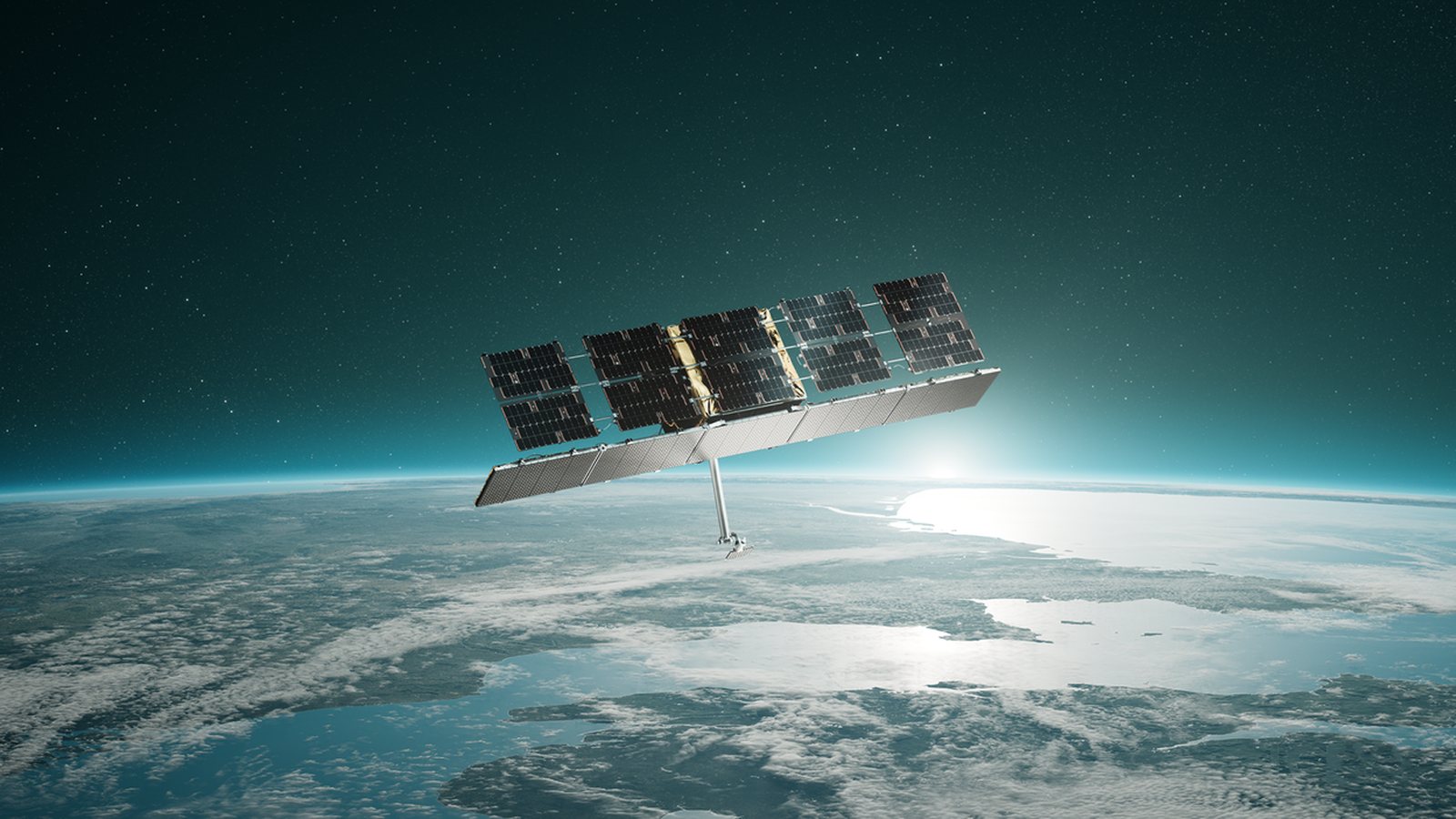
The first: Cosmos 2612. The second: ICEYE-X36, about 90 kg, registered in the United States according to CSIS, operated by ICEYE, a company founded in Finland, and part of a constellation used by Ukraine.
Langbroek calls it a "completely non-consensual" rendezvous. According to Space War Watch, astrophysicist Jonathan McDowell (Harvard-Smithsonian) said on X that, if the data are confirmed, this would be the first known rendezvous in low Earth orbit between two active satellites without the approval of one of their owners.
A story known since the spring
On 16 April 2026, Russia launched six satellites, Cosmos 2609 to 2614, from Plesetsk. In May, according to CSIS, five of them aligned with the orbital plane of the ICEYE satellite through fuel-hungry manoeuvres (four, according to the Space Force). On 26 May, Cosmos 2609 passed within 2.5 km.
Washington is not unaware. In a public fact sheet current as of July, the Space Force writes that in May Russia positioned four military satellites close to a "Western commercial radar satellite used by Ukraine for imagery intelligence".
On 9 October, the head of German Space Command, Major General Michael Traut, told Reuters that Russian satellites were "chasing" ICEYE's satellite. The company confirmed it was one of its own; its CEO said it had moved the satellite, prompting further Russian manoeuvres.
October: the return, then the silence
On 30 September, Cosmos 2612 set off again: manoeuvres on 30 September and on 12, 15 and 16 October (Langbroek). On the 12th, a 27.9 m/s burn put it into X36's plane and altitude, according to the analysis firm Integrity ISR.
On 17 October, the radar tracking company LeoLabs measured roughly 3 miles (≈ 5 km) and a movement that "appears to be a deliberate approach", Axios reported. For Clayton Swope (CSIS), it is "bumper‑to‑bumper", he told Axios.
« This is all unusual, and it just points to a purposeful engagement between Russia and a Western-run satellite that's supporting Ukraine. »
Officially? The Pentagon and ICEYE declined to comment, according to Axios. As of the morning of 19 October, nothing either from US Space Command, Moscow, Helsinki or Brussels on this approach, to our knowledge and to that of the monitoring site Space War Watch.
Who protects ICEYE-X36?
On paper, the 1967 Outer Space Treaty has an answer: the State of registry retains jurisdiction and control over the object (Article VIII) and bears responsibility for the activities of its companies (Article VI). Here, according to CSIS, the United States.
But the operator was born in Finland, a NATO and EU member, and its known customer in this war is Ukraine: in January ICEYE announced an agreement with "a customer within the Ministry of Defence of Ukraine". A Ukrainian official nevertheless told Axios it was unclear whether X36 in particular supports his country.
The treaty offers a tool: a State that fears potentially harmful interference from another may request consultation (Article IX). To our knowledge, no such request has been made public.
As for distances, Aaron Brynildson, a space law professor at the University of Mississippi, told Axios there is no strict legal limit, but countries generally stay beyond six miles (≈ 10 km).
In July 2020, Cosmos 2543 released an object travelling at 186 m/s, condemned by Washington and London; CSIS notes no such test near a non-Russian satellite. In 2022, at the UN, a Russian diplomat warned that "quasi-civilian infrastructure" used for military purposes "may become a legitimate target for retaliation". Cosmos 2612's intent, for its part, remains unknown.
Counter-reading
What the official story doesn't tell you
Here, there is no official story. That is precisely the problem. Here is what the silence leaves out.
- Governments knew in the spring: the Space Force publicly documented the May manoeuvres around a Western commercial radar satellite "used by Ukraine". On the October approach, the Pentagon declines to comment.
- The data are public, the analysis is private: orbital elements are released by US forces via Space-Track and republished by CelesTrak. It is LeoLabs, Integrity ISR, CSIS and astronomers who read them out loud.
- Protection has no declared owner: US registration, Finnish-born operator, Ukrainian customer. To our knowledge, none of these States, nor the European Union, has said publicly what it would do in the event of an incident.
- The satellite is small, and perhaps not very manoeuvrable: about 90 kg; its last detectable manoeuvre dates from late June, and it is unknown whether it can still evade, according to Integrity ISR.
We analyse documents and public statements, not people.
- Has ICEYE-X36 been operating normally since 18 October?
- What is Cosmos 2612's mission?
- Who, among Washington, Helsinki and Brussels, says it is responsible for this satellite?
According to public tracking data, a Russian military satellite has joined a Western satellite in orbit. Washington had known since the spring. The question is who will say, out loud, where the red line is.
Fact-check
The fact-check, point by point
Each claim in circulation, checked against the available documents: the CSIS analysis, the Axios report, Marco Langbroek's blog, the Integrity ISR newsletter, the Space Force fact sheet and public orbital elements. Click on a point to read the analysis.
What the official version says
On 15 October 2026, CSIS (Clayton Swope and Chantal Li) published an analysis stating that, based on commercial space situational awareness data, the Russian satellite Cosmos 2612 was on a trajectory bringing it into very close proximity to a commercial radar satellite registered in the United States and operated by ICEYE, a company founded in Finland. CSIS recalls past Russian tests (Cosmos 2543 in 2020) and argues that policymakers should assume Cosmos 2612 could threaten the satellite.
On 17 October, Axios reported, citing LeoLabs, that Cosmos 2612 was about three miles from ICEYE-X36 and quoted several experts; the Pentagon and ICEYE declined to comment. The same day, astronomer Marco Langbroek described a "non-consensual" rendezvous on his blog, then estimated on 18 October that a close pass had probably occurred around 01:35 UTC.
Claims checked
Needs context This is the first rendezvous in low Earth orbit between two active satellites without the approval of one of their owners (Jonathan McDowell, on X, 17/10/2026, paraphrased)
According to Space War Watch, the astrophysicist framed it conditionally ("if correct") and to his knowledge, pending further data. Langbroek also calls the operation "non-consensual".
We have not consulted the original post on X directly: we paraphrase it, without quotation marks. Being the "first" depends on what is public; non-public operations cannot be ruled out.[3][5]
Accurate "Appears to be a deliberate approach toward" ICEYE-X36; "While the intent remains uncertain, the behavior warrants continued monitoring" (LeoLabs, statement quoted by Axios, 17/10/2026)
The quote is attributed to LeoLabs by Axios. According to the same source, about three miles (≈ 5 km) separated the two satellites on the afternoon of 17 October, down from more than 200 miles the day before.
LeoLabs itself describes the intent as "uncertain".[2]
Needs context Cosmos 2612 passed "within a few hundred meters or possibly (much) closer" to ICEYE-X36, around 01:35 UTC on 18 October (Marco Langbroek, update of 18/10, 14:30 UTC)
The estimate relies on public orbital elements (TLEs), whose uncertainty is of the order of a kilometre, as Langbroek himself stresses. He also notes small manoeuvres by Cosmos 2612 at the same time, which complicate the calculation.
He sees, however, no indication that ICEYE-X36's orbit was disturbed.[3]
Unsubstantiated "Policymakers should assume Cosmos 2612 could take an action that threatens the commercial satellite" (CSIS, 15/10/2026)
This is an expert recommendation, not a fact: CSIS presents it as a working hypothesis based on past Russian tests, notably Cosmos 2543 in 2020. It also writes that "no one should assume to know" what Russia will do next with Cosmos 2612.
CSIS notes that no such test has been publicly documented near a non-Russian satellite.[1]
Unsubstantiated Cosmos 2612 is an "inspector" satellite from the Nivelir programme (experts quoted by Space War Watch)
These are identifications by independent experts, with no Russian or US confirmation. To our knowledge, Russia has not publicly declared Cosmos 2612's mission.[5]
Needs context ICEYE-X36 "supports Ukraine" (CSIS; Greg Gillinger, Integrity ISR, to Axios)
ICEYE supplies data to Ukraine and announced in January an agreement with a customer within Ukraine's Ministry of Defence. But a Ukrainian official told Axios it was unclear whether X36 in particular supports his country, and Langbroek writes "reportedly".
We therefore write "a constellation used by Ukraine", never "the Ukrainian satellite".[1][2][3]
Partly verified The Pentagon and ICEYE decline to comment; no government has spoken
The Pentagon's and ICEYE's refusal to comment is reported by Axios; Space War Watch says it found no official statement. We found none either as of the morning of 19 October.
But governments have not always been mute: the Space Force documented the May manoeuvres in a public fact sheet, and the head of German Space Command spoke to Reuters on 9 October. The silence concerns the October approach.[2][5][6][7]
To be clarified 26 m conjunction between Cosmos 2612 and ICEYE-X36 on 19/10/2026 at 16:07 UTC (OrbitalRadar)
Sourced counter-arguments
Rendezvous and proximity operations can be benign: inspection, servicing, debris removal. CSIS acknowledges this.[1]
Intent remains uncertain according to LeoLabs, and attribution is "very difficult in space", Langbroek stresses.[2][3]
No disturbance of ICEYE-X36's orbit appears in public orbital elements, according to Langbroek, and no interference has been documented.[3][5]
The United States also practises orbital approaches: according to the Space Force, its GSSAP satellites, in geosynchronous orbit, can manoeuvre near objects of interest to observe them.[11]
According to Space War Watch, McDowell does not think this approach quite violates the Outer Space Treaty, and Cosmos 2612 appeared to be drifting away after 18 October.[5]
Questions that remain open
- Has ICEYE-X36 been operating normally since 18 October?
- What is Cosmos 2612's mission, and will it come back?
- Who, in Washington, Helsinki or Brussels, takes responsibility for protecting a commercial satellite used in a war?
- Has a request for consultations under Article IX of the Outer Space Treaty been considered?
In short
According to public tracking data, Cosmos 2612 did carry out an unsolicited approach manoeuvre towards ICEYE-X36, which experts consider without known precedent between two active satellites in low Earth orbit. What is documented: the manoeuvres, their fuel cost, the proximity. What is not: the intent, the exact use of X36, and any interference. What is missing above all: a public word from the governments concerned on the October approach.
Sources
- Could Russia Be Poised to Use an On-Orbit Weapon Against a Commercial Satellite? — Clayton Swope and Chantal Li, 15/10/2026 — CSIS · accessed 19 October 2026
- Russia nears U.S. satellite, raising alarm about intent — 17/10/2026 — Axios · accessed 19 October 2026
- [UPDATED] KOSMOS 2612 and ICEYE-X36: a worrisome cat-and-mouse-game in Space — Marco Langbroek, 17/10/2026, updated 19/10/2026 at 10:00 UTC — SatTrackCam Leiden (blog) · accessed 19 October 2026
- The Integrity Flash, issue 155: "Russia: Cosmos 2612 – Climbing Out to Close In" — Integrity ISR (ISR University) · accessed 19 October 2026
- Space War Watch: Cosmos 2612 / ICEYE-X36 tracker, updated 18/10/2026 (secondary compilation: McDowell, Langbroek, LeoLabs) — America 2.0 · accessed 19 October 2026
- Space Threat Fact Sheet (current as of July 2026) — US Space Force · accessed 19 October 2026
- Russian satellite activity raises concerns for Starlink, German space commander says — Reuters, 09/10/2026 — Reuters (via Investing.com) · accessed 19 October 2026
- COSMOS 2612 ⟷ ICEYE-X36: computed 26 m conjunction, 19/10/2026 16:07 UTC (automatic calculation, changing value) — OrbitalRadar · accessed 19 October 2026
- Treaty on Principles Governing the Activities of States in the Exploration and Use of Outer Space (1967), Articles VI, VIII and IX — UN Office for Outer Space Affairs (UNOOSA) · accessed 19 October 2026
- Statement by Mr. Konstantin Vorontsov, First Committee of the General Assembly, 26/10/2022 (unofficial translation) — United Nations (eStatements) · accessed 19 October 2026
- Geosynchronous Space Situational Awareness Program (GSSAP), fact sheet — US Space Force · accessed 19 October 2026
AI-assisted content: this article was written with the help of artificial intelligence from public sources, then reviewed and approved by a human editor before publication. Spotted an error, want to respond? Exercise your right of reply · our method.